Sports Team Photographer Melbourne: Choosing the Right Gear for Fast Sports
Fast sports photography looks straightforward until you’re on the sideline, the action is coming at you from three directions, and the light is changing every minute. I’ve missed shots for reasons that had nothing to do with skill, and I’ve nailed sequences because the gear made the hard moments survivable. The difference is usually not “the most expensive camera,” it’s the right balance of autofocus performance, shutter speed, burst depth, lens reach, and how quickly you can move from one camera setting to the next without thinking.
If you shoot sports teams regularly in Melbourne, you’ll also notice the local rhythm: late afternoon glare, sudden cloud cover, stadium lighting that can shift color, and the constant movement of players between warm-up areas and match fields. That’s why sports team photography in Melbourne is as much about dependable workflow as it is about capturing peak moments.
Below is how I choose gear for sports team photos and Sports League Photography Melbourne style assignments, with a focus on speed and consistency. I’ll cover cameras, lenses, support, lighting, storage, and a few “gotchas” that don’t show up in product spec sheets.
What “fast sports” really demands from your gear
When people say “fast action,” they often mean high shutter speeds and long lenses. Those are essential, but the deeper requirement is tracking reliability. Fast sports is messy: players cross each other, someone’s head blocks your subject, the ball changes direction quickly, and there are moments where your autofocus momentarily locks onto the wrong thing.
Your gear needs to handle four tasks at once:
First, it must freeze motion. That’s not optional. Second, it must keep autofocus locked through occlusion and sudden direction changes. Third, it needs enough burst rate and buffer depth to get the peak frame when the moment happens. Fourth, it has to let you keep exposure stable when lighting shifts, because a sequence of 20 frames that drifts one stop can look inconsistent even if every single frame is sharp.
In practice, the “right” gear is the gear that gives you the highest hit rate on real games, not ideal test conditions.
Camera bodies: prioritize autofocus consistency over megapixels
Megapixels are useful, especially if teams want large prints or you’re delivering high resolution for squad updates. But for fast action, I’d rather have a camera that holds autofocus correctly for the whole match than one that offers extra detail in a single perfect frame.
For Sports Team Photographer Melbourne work, you’re usually delivering:
- group photos that need reliable focus and flattering skin tones
- action sequences that need tack sharp subjects and low missed frames
- coverage that often happens back to back with minimal downtime
That means I look for a body with strong subject detection and responsive tracking. Sports relies on keeping the camera “interested” in the athlete, not the background. When the player turns their head, jumps, or is partially blocked, the system should stay committed.
I also pay attention to burst depth. A high frame rate is meaningless if the camera slows down after the first couple of seconds. During a breakaway, the peak moment can land right in the part of the burst where buffer fills and performance drops. That’s when you start hearing the dreaded “thunk… pause… thunk” rhythm in your head.
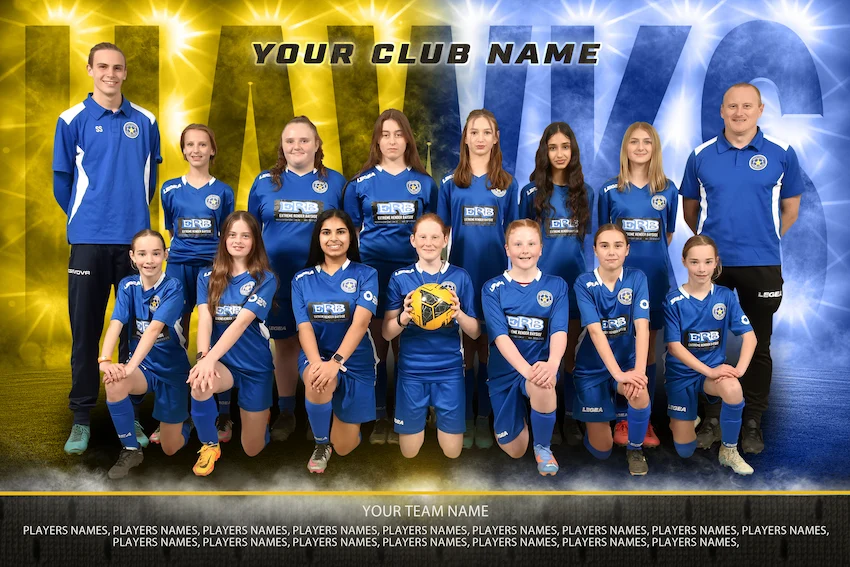
If you’re shooting Team Group Photography Melbourne sessions, you’ll also benefit from reliable face or subject detection for posed shots. Still, the priority is action capture, because that’s where your hit rate determines whether the client trusts you with full match coverage.
A practical approach I use on the day
I don’t rely on constant reconfiguration. I start the match with a set of settings that are close enough for the lighting, then refine only when the environment changes.
In bright daylight, I aim for shutter speeds that freeze action, and I keep aperture and ISO in a range that maintains crisp focus. If you’re in a stadium with mixed lighting, shutter speed still leads, but exposure control becomes more about consistency than absolute brightness.
Lenses: choose for reach, speed, and autofocus behavior
A lens can ruin your day even if the camera body is excellent. With fast sports, the lens is where you either get separation and clarity or you end up cropping too far and losing sharpness.
Reach matters more than you think
For Melbourne fields and grounds, distance varies wildly based on where the media position is allowed, fence placement, and how the sport is set up. I often end up shooting from sideline positions where you cannot walk closer without losing access.
That’s why long focal lengths are common in Sports League Photography Melbourne coverage. A telephoto zoom gives you flexibility when play moves toward you, away from you, or across the frame. Prime lenses can be sharp and fast, but you pay a price in composition speed. For team photography, being able to reframe instantly is part of being “fast” as a photographer.
Autofocus performance with sports lenses
Look at two things: how quickly the lens focuses and how reliably it tracks when the subject crosses the frame. Some lenses focus fast in isolation but struggle when the background is busy. Others are smooth but not aggressive. You want a lens that snaps into place without feeling indecisive.
Stabilization is helpful when you’re panning or when you’re shooting less action-heavy moments, but stabilization doesn’t freeze subjects. It helps you keep your framing steady, which can support sharper results when your shutter speed sits near the edge for the sport. When the sport is truly fast, you still drive shutter speed high enough to freeze motion.
Aperture trade-offs
Wide apertures help isolate players from the background, and they reduce ISO needs. But in a lot of team action, you need enough depth of field to keep the subject’s face and torso inside the plane of focus as they move. That’s a judgment call, and it depends on focal length, subject distance, and how tight your framing is.
For group and Team Group Photography Melbourne style photos, you typically stop down anyway. For action, the balance is trickier.
Shutter speed and exposure: freeze motion without killing consistency
Shutter speed is the easiest knob to understand and the hardest to apply consistently. If you shoot too slow, motion blur turns into “softness,” and clients interpret that as lack of sharpness, even if the camera is technically focused.
As a rule, fast ball sports and quick sprints often need higher shutter speeds than you think, especially when players jump, collide, or swing a limb toward the ball. I aim for shutter speeds that align with the sport’s movement patterns. For example, you can get away with lower shutter speed for some slower tracking moments, but breaks, tackles, and shots toward goal usually demand higher settings.
Exposure is the second half of the equation. In Melbourne, clouds can roll in suddenly. Stadium lights can also create color shifts that affect skin tones. If your camera auto exposure swings too much between sequences, your gallery can look inconsistent.
So I keep exposure behavior predictable:
- I avoid letting the camera chase extreme bright-to-dark swings mid-burst.
- I use manual exposure where it helps, especially when the lighting is stable for a full quarter or period.
- When lighting changes, I adjust deliberately, then shoot through the next segment to gather consistent sequences.
You can get stunning Sports Team Photos Melbourne sets when the exposure stays coherent across the match. It’s not just technical correctness, it’s the visual feeling of a complete story.
Autofocus settings: the difference between “sharp” and “reliably sharp”
Autofocus modes and configuration vary by camera brand, but the concept is universal: you need continuous tracking, and you need it to prioritize the athlete rather than the background.
In real games, you’ll see three common autofocus failures:
- The camera locks onto a contrasting object behind the athlete.
- The camera struggles when players overlap and occlude each other.
- The camera “gives up” during rapid direction changes.
The fix is usually not to slow down. It’s to tune autofocus sensitivity and tracking behavior so it can stay with the subject through distraction.
If you only change one thing before the match, change your autofocus tuning. Then test it during warm-up and the first few minutes of play. Warm-up is where you discover whether your lens-to-camera pairing behaves the way you expect at match distances.
Burst rate and buffer depth: capture the peak frame
The peak frame in fast sports is short, often less than a second. That means you want enough frames to cover the moment, not just enough to confirm focus.
But the real problem is buffer limits. Cameras with great burst rates sometimes slow down once the buffer fills, which can happen during a long phase of continuous play. When the buffer drains, you miss the next peak moment because your camera needs time to catch up.
That’s why I think of burst depth as “insurance.” If your camera can hold a sustained sequence at your chosen frame rate, you’ll feel calmer during hectic phases. Calmer usually means better timing and better framing.
If your setup is borderline on buffer, you can reduce burst by shooting shorter bursts. That’s a workflow decision, not just a technical one. For Sports Team Photographer Melbourne assignments where you might switch between action and posed photos, shorter controlled bursts can also help you avoid filling storage too quickly.
Lens choice by sport: quick judgment calls I make
Different sports move differently. A wide receiver sprint has a different rhythm than a goalkeeper dive. A hockey swing behaves differently than a soccer tackle. You don’t need different camera bodies for each sport, but you do need focal lengths and lens behaviors that fit the movement.
Here’s how I generally decide:
- If the sport has frequent close contact and unpredictable direction changes, I lean toward zoom flexibility so I can reframe without relocating.
- If the sport is often played with predictable depth lanes and you’re shooting from farther back, I lean harder into reach.
- If you’re covering both action and group photos, I keep a lens setup that transitions quickly from the field to the sidelines where squad shots happen.
This is exactly where Melbourne Sports Team Photography benefits from practicality. Clients often want action variety plus complete coverage, not just a single tight focal length style. The camera and lens pairing should support both without slowing you down.
Support gear: tripods can help, but sideline stability usually beats it
Most fast sports photography is handheld or monopod-assisted. Tripods work in some venues, but if you’re moving along the boundary or changing angles between plays, a heavy tripod becomes a liability.
Stability is still important, especially at long focal lengths. A monopod can reduce fatigue and improve steadiness for long match coverage. If you’re panning, smoother movement matters more than people expect.
I also pay attention to how the rig sits when you’re switching from action to group photos. If you need to disassemble and reconfigure constantly, you will miss moments. Your best “support” is the setup that stays ready.
Lighting: when you need flash and when you should avoid it
Team Group Photography Melbourne sessions often include indoor spaces or evening captures where light levels drop. Flash can work, but it has to be used thoughtfully.
In action sports, flash is usually not practical unless you’re dealing with very specific environments like controlled arenas and you’re close enough to get meaningful exposure on the subject. In most outdoor matches, flash is either wasted or looks obvious.
For group photos, flash can be a useful tool because posed subjects allow you to control the light and composition. The key is matching ambient and flash exposure so the result looks natural, not like players are standing in front of a spotlight.
If you shoot both action and team photos, I keep my flash strategy separate. I don’t want to be flipping power settings and trigger modes mid-match. That kind of workflow drag costs you continuity.
Storage, workflow, and backup: the part clients never see
Gear choice isn’t only about capture. It’s about what happens after you press the shutter.
Sports Team Photography Melbourne deliverables can be large: a gallery per match, highlights, plus select individual portraits for squad sets. You also might be delivering to multiple stakeholders, coaches, schools, or clubs that want different subsets of images.
That means I build my workflow around:
- fast card reading and reliable backups
- predictable naming and folder organization
- enough buffer in the field so you can keep shooting without worrying about storage overflow
A simple practice that saves headaches: I verify that cards are working properly before leaving the first venue of the day. If you’re traveling between grounds, you don’t get a second chance.
Also, I avoid relying on a single backup approach. If I capture on two cards, I don’t treat one card as optional. Redundancy is cheap compared to the cost of losing a match.
The gear setup I recommend for most Melbourne sports sideline situations
I’m not going to pretend there’s one perfect kit, because the venues and sports vary. But there is a reliable “foundation” that covers most fast action and still lets you pivot to Sports Team Photos Melbourne style group coverage.
Think in terms of two priorities: keep your shutter speed where it needs to be, and keep your framing flexible without slowing down.
If you want a practical setup approach, here are the core components I look for.
- A camera body with strong continuous autofocus tracking and dependable buffer depth for burst sequences
- A telephoto zoom in a useful range for sideline distances, with fast autofocus behavior
- A second lens option suitable for group portraits and tighter portraits, or a focal length that handles both without swapping constantly
- A support method that you can hold comfortably for extended periods, often handheld plus a monopod
- A storage and backup workflow you can trust when you are exhausted after the match
That’s not an instruction manual, it’s a philosophy. In fast sports, the best gear is the gear that stays consistent when your attention is split between players, ball direction, and the coach’s instructions about where the team needs to stand for the next set.
Trade-offs that matter in real games
Every choice involves compromise. The trick is to make compromises that don’t kill your output.
Heavy lenses vs. Long sessions
A heavier lens can be sharper and offer better reach, but it can also slow your tracking. If your arms fatigue during a full quarter or two, your panning smoothness suffers. You might still get sharp frames, but your hit rate drops.
When I’ve done long days covering multiple age groups or back-to-back matches, I choose the lightest lens that still meets the framing requirements. Sometimes that means sacrificing a little reach, then compensating by repositioning when possible.
Maximum aperture vs. Practical depth of field
Wide open is great for isolation, but sports subjects move through space. If you shoot too wide open at long focal lengths, depth of field can be thin enough that the peak frame is sharp while the face is just slightly out. For athletes, faces matter.
So I often stop down a little compared to my “perfect conditions” settings. That’s not about theory, it’s about getting more consistently sharp expressions in the frame, not just sharp edges.
Auto exposure vs. Manual discipline
Auto exposure can help you adapt to cloud changes quickly. It can also swing when a bright kit enters the frame or when the background shifts. For a client gallery, consistent exposure looks professional even if one frame is technically not “perfect.”
That’s why I choose a middle ground: I keep a disciplined exposure strategy, then adjust based on observed drift rather than responding to every minor fluctuation.
Team group photos and action together: the transition that decides the day
One thing I’ve learned doing Sports Team Photography Melbourne for clubs is that action coverage and group portraits are linked by timing. If you lose the group photo window, you can’t recreate it with the same spontaneity.
The transition matters:
- During a match, you’re trained to react to play.
- For group photos, you’re trained to slow down, direct, and control backgrounds.
Your gear should support both modes. A camera that works well for continuous autofocus is still useful for group portraits, but lens selection and lighting setup can determine whether the group photos look flattering and consistent.
I’ve watched photographers change lenses repeatedly between match and group time, and I’ve seen them run out of time. A simple, consistent setup that stays ready beats a “perfect” setup that requires too many changes on the sideline.
Delivering a gallery that clients actually love
Sports League Photography Melbourne clients usually want two things: memorable action moments and clean, usable team images.
For Sports Team Photos Melbourne, that means the final selection needs variety:
- wide shots that show the team in context
- tight action sequences that show emotion and peak mechanics
- clear squad images with consistent exposure and focus
Gear helps you capture candidates, but selection is where the story comes to life. Still, you league photography Melbourne can’t select what you never captured. Good gear reduces the number of “almost” frames, and that reduces the temptation to compromise on the best moments.
If your gear gives you more sharp keeper frames, your editing process becomes easier. You can spend time curating instead of hunting.
Common questions from team photographers
“Do I need two camera bodies?”
You can do great work with one body, especially if you’re organized. Two bodies become helpful when you want to avoid lens swaps during match transitions, or if you’re covering large teams with tight scheduling. But the choice comes down to how often you switch focal lengths and how quickly you can pivot between action and group photos.
“What matters more, stabilization or faster lenses?”
For fast sports, shutter speed drives sharpness, stabilization helps your own steadiness and panning. Faster lenses help with shutter speed and background separation, but the biggest win still comes from autofocus reliability and shutter speed discipline.
“Should I shoot raw only?”
Raw gives you more control for exposure and color shifts, which matters in Melbourne light. If you’re delivering large galleries, raw workflow still has to be manageable. Many photographers shoot raw for action and use different strategies for lower priority shots, but the right approach depends on your editing capacity.
A final sideline check before you start shooting
Right before the match begins, I do a quick confirmation that takes less than a minute:
- focus mode is set for continuous tracking
- shutter speed targets are realistic for the sport
- autofocus behavior is consistent with how the lens hunts at distance
- cards and battery are ready for sustained shooting
- lens is clean, because dust on a telephoto can be surprisingly expensive in contrast
These aren’t glamorous steps, but they’re the ones that prevent the day from turning into salvage mode.
Wrap your kit around the reality of Melbourne sports
Choosing Sports Team Photographer Melbourne gear is about getting the best outcome under pressure. You want dependable autofocus, enough reach to frame athletes without stretching your crop, shutter speed that freezes the moments clients pay for, and a workflow that doesn’t threaten the delivery timeline.
If you focus on those fundamentals, you can cover everything from Melbourne Sports Team Photography squad updates to high intensity Sports League Photography Melbourne matches, while still keeping your transitions smooth. The best kits don’t just photograph action, they keep you in control when the play doesn’t.
Pure Sport Images
23 Grandview Ave, Mulgrave VIC 3170, Australia
+61 413 157 614
[email protected]
Website: https://puresportimages.com.au